

Perennial grasses summer dormancy to boost sustainable viticulture in the Mediterranean climate (PEGASUS)


The PEGASUS (Perennial grasses summer dormancy to boost sustainable viticulture in the Mediterranean climate) project addresses the sustainability of Mediterranean vineyards by utilizing summer-dormant perennial grasses as cover crops, with a focus on the genetics of drought adaptation. Its core research focuses on the genetic and physiological characterization of Poa bulbosa, aiming to identify the genes controlling dormancy onset and release through integrative genomic approaches. The project employs full-genome resequencing and pool sequencing of a diverse germplasm panel, combining genotype–environment association (GEA) and genotype–phenotype association (GWAS) analyses with canonical correlation analysis (CANCOR) to detect adaptive loci involved in summer dormancy and drought tolerance. These results will enable marker-assisted selection and the development of optimized Poa bulbosa genotypes for use as perennial cover crops in rainfed vineyards, contributing to the genetic design of climate-resilient agroecosystems.
________________
Sowing summer-dormant grasses to optimize water resources in Mediterranean woody crops (SIESTA)

Incorporating cover crops into perennial woody crops is one of the main objectives of sustainable agriculture worldwide and is actively promoted by European Union agricultural policy. However, cover crops pose a challenge in the Mediterranean climate due to their competition for water and nutrients with the main crop. Until now, cover crops composed of species with annual life cycles, ending in the dry season, have been chosen to minimize their impact. However, the overlap between the end of the cover crop’s life cycle and the beginning of the main crop’s life cycle creates competition and a negative impact on the agronomic yield of the main crop. In addition, annual species are less effective than perennials in soil structure creation and carbon sequestration. Perennial cover crops have been largely ruled out due to their greater competition with the crop; however, summer-dormancy perennial cover crops, which minimize competition with the main crop, are sustainable but unexplored alternatives. This project aims to evaluate the potential of Dactylis glomerata, a summer-dormancy perennial cover crop, in Mediterranean vineyards as a model for sustainable agriculture.
________________
Genomic characterization of Andalusian wine grapevine varieties to trace their domestication history and future genetic improvement (GENOVINES)


The GENOVINES project aims to develop a comprehensive genomic analysis of grapevines by sequencing full genomes of genotypes from the Andalusian region. This project aims to identify the origin of local varieties, the general genomic signature of their domestication, and the specific genomic regions that have been the target of selection since the earliest stages of viticulture in the region. In addition, we will conduct quantitative genetic analyses to identify specific genes of current agronomic interest aimed at improving production in the context of climate change. Knowledge of the origin of local varieties would make it possible to enhance their local character, which directly impacts the commercial value of the wines produced. Knowledge of the genes responsible for these agronomic traits is lacking in the literature. It will constitute a first step toward the genetic improvement of Andalusian grapevines in the context of global warming.
________________


Identification of the genomic signatures of climate change in permanent grasslands through resequencing and experimental studies in allochronic populations (Chronos)
The CHRONOS project integrates concepts of ecophysiology, evolution, quantitative genetics and genomics into a novel framework for the study of climate adaptation. The project includes the presentation of an evolution and resequencing (E&R) study on plants carried out in a natural environment (in situ E&R). This E&R study aims to directly assess the adaptation of plants in situ to climate change using a resurrection approach with populations sampled with a high temporal difference (c. a. 50 years). Additionally, it aims to identify adaptive genes associated with both phenotypic responses to climate and phenotypic plasticity in natural plant populations. From a technical point of view, our interdisciplinary approach could establish a new framework for the study of the genomics of adaptation to climate change using allochronic data. We apply this methodological framework to the species Festuca pratensis, a perennial fodder grass of high agronomic value that is dominant in natural and semi-natural grasslands in Europe.
________________


Boosting the genomic adaptation to anthropogenic climate change in a European grassland species (GrassClim)
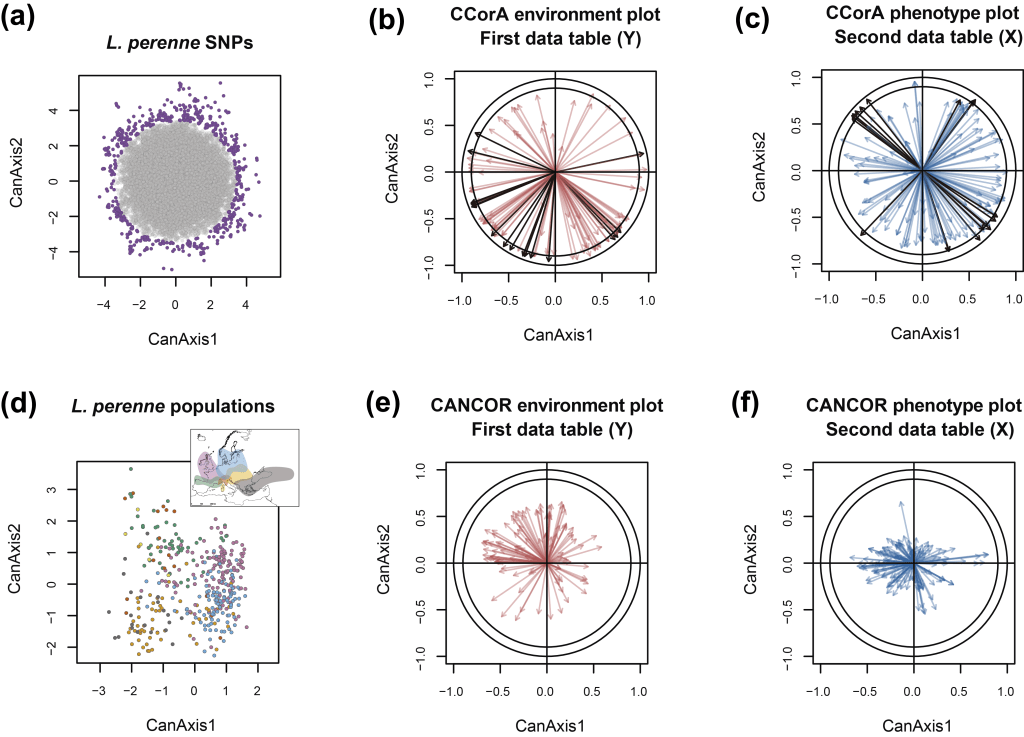
Grasslands represent the most widespread agricultural land use in Europe. They are the basic source of feed for livestock and provide essential ecological services. Modern breeding has only taken advantage of a limited part of the potentially useful genetic variations existing in nature. This natural diversity still represents an essential genetic resource for breeding to improve forage production or adaptation to environmental constraints. Grassland species are indeed adapted to their local environment, but there is a risk that local populations will often lack sufficient variation to adapt to rapid climatic shifts. We focus on Lolium perenne L. (perennial ryegrass), which is a major grass species naturally distributed over Europe and its surroundings. The objectives are: i) to reconstruct the evolutionary history of wild Lolium pernn, and ii) to use landscape genomics and quantitative genetic tools to discover genetic variability involved in climatic adaptation in natural populations. The final aim is to identify genomic polymorphisms in perennial ryegrass expected to provide adaptation to future climatic conditions.
________________

Adaptation and evolution of wild alfalfa: a genomic approach (AlfalfaEvolution)
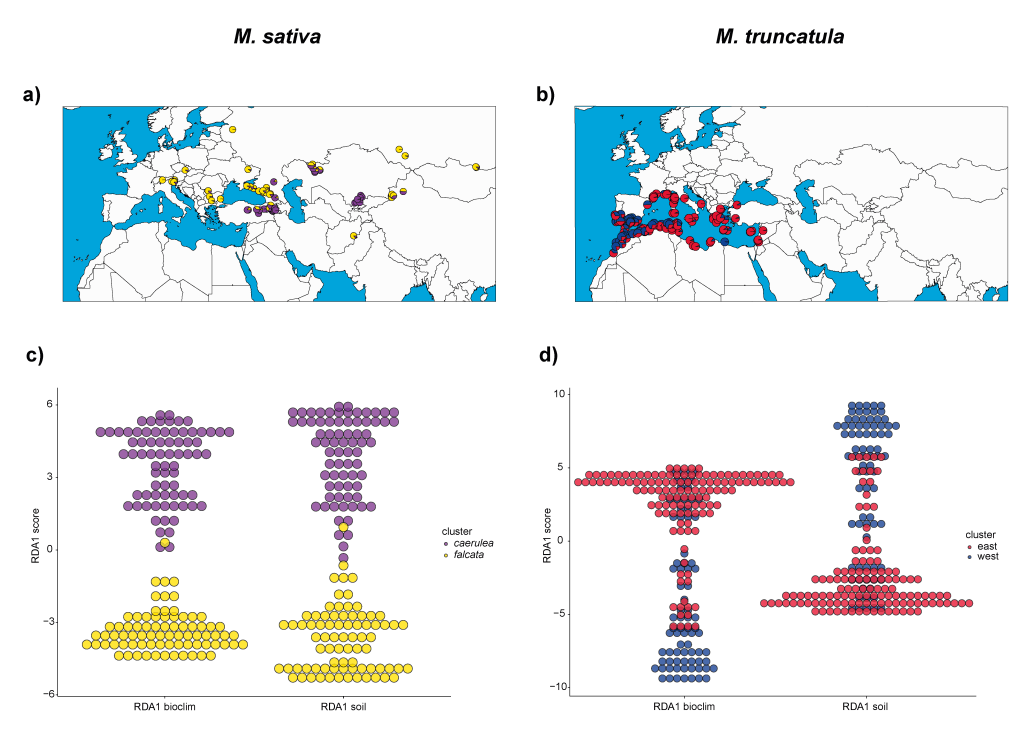
The Eurasian genus Medicago is best known for the perennial species M. sativa (alfalfa). Alfalfa is the world’s oldest, most important, and most intensively studied fodder crop. There is huge promise for extending the importance of alfalfa well beyond its present primary use as a feed for livestock. This species has potential uses in several domains such as pharmaceuticals, biodegradable plastics, biofuels, textiles, and human nourishing. Medicago sativa is a polymorphic species with a variation pattern that has been complicated by hybridization and gene flow, mediated naturally or by human forces. The objectives are to characterize wild genetic pools and investigate genomic footprints of adaptation to climate in wild Medigaco sativa and the model species Medicago truncatula. Identification of genes responsible for climatic adaptation could help develop breeding programs aiming to create new varieties adapted to a changing climate.
 PLANTAE LAB